

 To launch labAlive simulation applications you need a Java Runtime Environment supporting Java Web Start on your system. Here you can get more information about installing the right Java version.
The modulating signal is fed to the horizontal input of the oscilloscope. The amplitude curve of the signal can be determined in the vertical axis. The amplitude of the signal is adjusted to produce a usable trapezoid.
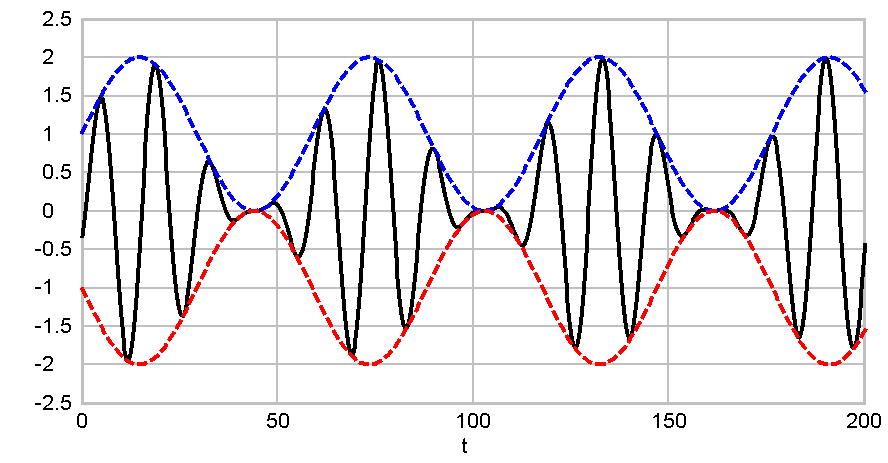 Transmission Signal with modulation index of 1.
|
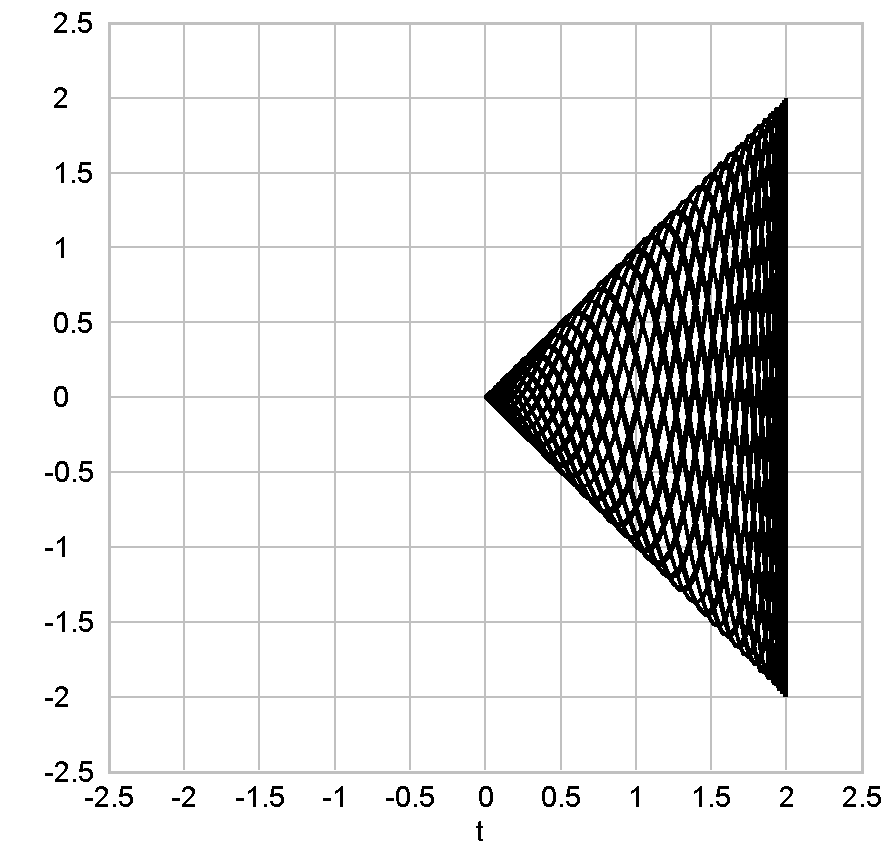 Trapezoid with modulation index of 1.
|
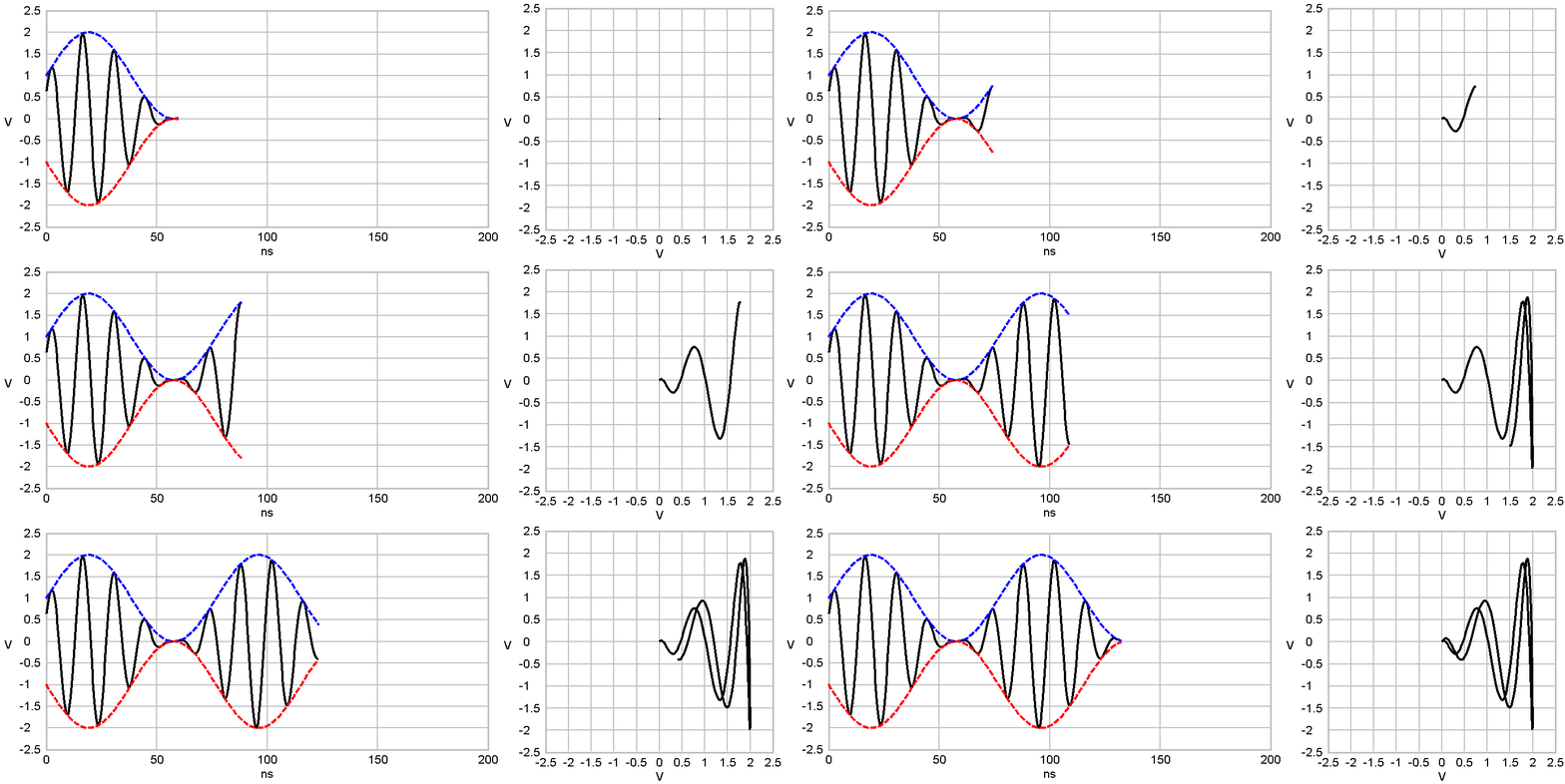
Experiment

Basically, we use the sinusoidal signal as the input signal.The reason is that an audio track is mostly sinusoidal.
Ultimately, the Java application also makes it possible to check the shape of the trapezoid. Changing the modulation index changes the trapezoid. In the following table you can use the information gained from the AM section to prove your knowledge.
Compare the differences in the next experiment and try to explain why the respective signals look like this.
| Modulation index | Transmissionsignal | Trapezoid |
| 1 |
|
|
| 0.5 |
 |
  |
| infinitely large |
 |
 |
Ultimately, the Java application also makes it possible to check other input signals. The trapezoid builds up very cleanly with a sinus function. However, changing the signal can also change the structure.
Compare the differences in the next experiment and try to explain why.
 Transmission signal is a triangle.
|
 The trapezoid generated by the transmission signal.
|
 Transmission signal is a triangle with infinitely large modulation index.
|
 The trapezoid generated by the transmission signal.
|
 Transmission signal is a sawtooth.
|
 The trapezoid generated by the transmission signal.
|
 Transmission signal is a square.
|
 The trapezoid generated by the transmission signal.
|